
Every symptom tells the story of an adaptation before it tells the story of a disease.
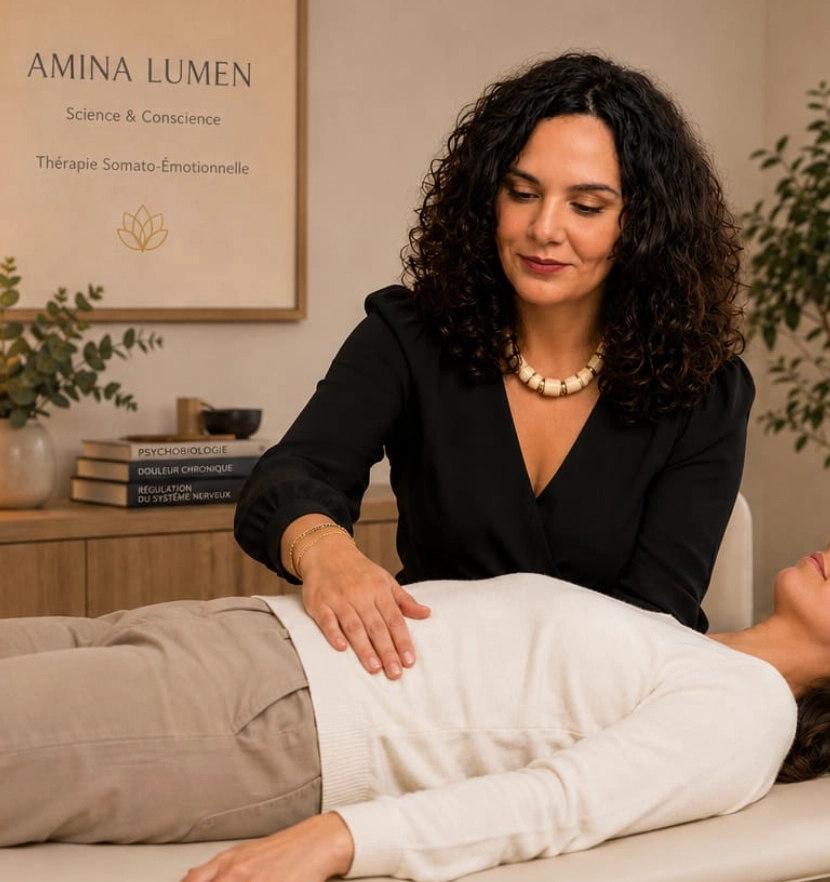
Somatic therapy explores the relationship between the body, nervous system regulation and emotional experiences. Persistent pain, chronic tension, fatigue or unexplained physical symptoms may continue even when medical examinations are reassuring. Rather than asking only what is wrong, this approach also explores what the body has been trying to protect or regulate. Grounded in biology, physiology and nervous system regulation, Somatic & Emotional Biology complements medical care by supporting the body's natural capacity for regulation and adaptation.
Persistent pain, tension or fatigue can continue even when medical exams are reassuring. This approach explores what the body may still be trying to protect or regulate, alongside medical care.
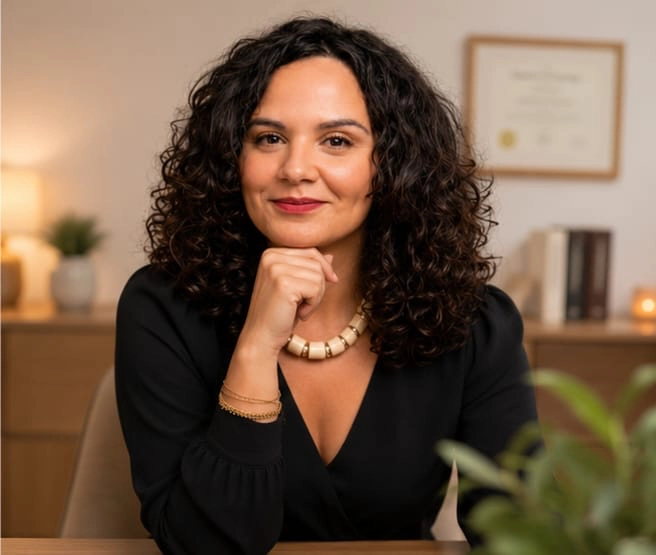
Every person's journey is unique. Yet some physical symptoms, life transitions or periods of intense adaptation may invite us to look beyond the symptom itself and explore the relationship between the body, physiology and lived experience.
Every journey is unique. Some symptoms or life transitions invite us to look beyond the symptom and explore the body's adaptation.
You do not need to relate to every situation described below. Sometimes, recognising just one element is enough for an exploration to make sense.
You experience persistent or recurring pain, physical tension, stiffness, discomfort, or you are recovering from an injury or medical procedure. The body may continue to activate adaptive responses that were once useful but no longer fully meet present needs.
Persistent pain, tension, stiffness, or recovery from an injury or procedure — the body may still activate adaptive responses that no longer meet today's needs.
Long-lasting fatigue, disrupted sleep, chronic stress, hormonal transitions or periods of major physiological change can place significant demands on the body's adaptive capacities — whether related to fertility, parenthood, menopause, andropause or other stages of life.
Long-lasting fatigue, disrupted sleep, chronic stress or hormonal transitions — fertility, parenthood, menopause or andropause — place real demands on the body's adaptive capacities.
Surgery, chemotherapy, chronic conditions, fertility journeys or symptoms that persist despite reassuring medical assessments and previous approaches... This complementary support considers both the body's experience and the emotional impact throughout these journeys.
Surgery, chemotherapy, chronic conditions, fertility journeys or persistent symptoms despite reassuring assessments — complementary support for the body's and emotional experience.
Burnout, grief, separation, professional changes, family transitions or periods of uncertainty... Some life experiences can continue to influence the way we relate to our bodies and mobilise our adaptive resources over time.
Burnout, grief, separation, career changes or family transitions — life events that can shape our relationship to the body over time.
Beyond the symptom, the intention is to understand how your body has adapted throughout your history and to support its natural capacity for regulation, while respecting medical care whenever it is needed.
Beyond the symptom: understanding how your body has adapted, to support its natural capacity for regulation — alongside medical care when needed.
You do not fully identify with these situations? Every story is unique. This approach is centred on the person, not on a list of symptoms.
Every person has a unique history, physiology and capacity for adaptation. This is why my work does not rely on a single method or standardised protocol, but on a global understanding of your situation to create a truly personalised therapeutic journey.
Every person has a unique history and capacity for adaptation. My work isn't a standardised protocol — it's shaped by a global understanding of your situation.
My practice is based on an integrative physiological regulation approach, exploring the interactions between physiology, the nervous system, emotional experiences, life events and the individual's environment. This approach draws in particular from Somatic & Emotional Therapy principles.
My work is shaped by a dual background: an initial scientific education in biology, complemented by specialised training exploring the relationship between the body, emotions and physiology. This combination supports an approach that is both rigorous, sensitive and deeply human.
This global perspective allows the sessions to be adapted to your individual situation rather than applying the same protocol to everyone. Different tools are selected according to your needs, your pace and the objectives defined together.
My practice is based on an integrative physiological regulation approach, shaped by a scientific background in biology and specialised training in Somatic & Emotional Therapy.
This global perspective allows sessions to adapt to your situation, rather than applying the same protocol to everyone.
Understand before acting. Observe before interpreting. Adapt rather than apply.
Symptoms are never considered in isolation. They are explored within a wider context, where the body, emotions, life circumstances and adaptive capacities are understood through their interactions.
Symptoms are never viewed in isolation — body, emotions, life circumstances and adaptive capacities are considered together.
The sessions combine therapeutic dialogue and structured somatic exploration, including Somatic & Emotional Therapy, always with your consent and adapted to your individual situation.
Sessions combine dialogue and structured somatic exploration, including Somatic & Emotional Therapy, always with your consent.
Every journey is unique. The tools and approaches used evolve throughout the sessions to remain aligned with your needs, your goals and your personal progression.
Every journey is unique — tools and approaches evolve throughout the sessions, aligned with your needs and progress.
Every therapeutic journey begins with a time of listening and exploration. Sessions are built progressively, respecting your situation, your goals and your own pace of change.
Every journey begins with listening and exploration, then builds progressively at your own pace.
Discover how sessions unfoldEvery person arrives with their own history, experiences and needs. There is therefore no predefined session format. The first appointment provides an opportunity to understand your situation, identify your needs and establish the foundations of a personalized therapeutic journey.
Every person arrives with their own history and needs — there's no predefined format. The first appointment lays the foundations of a personalised journey.
The first session allows us to meet, establish the framework of the therapeutic relationship and understand your personal history, your journey and what brings you here today.
The first session is about meeting, setting the framework together, and understanding what brings you here today.
Together, we explore your situation from a global perspective, considering the interactions between your body, your experiences, your environment and your adaptive capacities.
Together, we explore your situation globally — body, experiences, environment and adaptive capacities, all considered together.
Depending on your situation, sessions may combine different tools from Somatic & Emotional Therapy®, therapeutic hypnosis and other complementary approaches. Each proposal is explained, adapted to your needs and implemented only with your consent.
Sessions may combine tools such as Somatic & Emotional Therapy, hypnosis and other complementary approaches — always explained and implemented with your consent.
The therapeutic journey evolves over time to remain aligned with your situation, your needs and your progression.
Your journey evolves over time, staying aligned with your situation and progress.
You remain fully involved throughout your therapeutic journey. Every proposal is explained, discussed and only implemented with your agreement.
You remain fully involved throughout: every proposal is explained and only implemented with your agreement.
Some changes may be experienced from the first sessions, while others require more time. The duration of the therapeutic journey depends on your situation, your objectives and your personal rhythm. This is a short-term approach: the intention is to support you for the time that is appropriate, according to your evolution.
Some changes come early, others take more time. This is a short-term approach: support for as long as it's genuinely useful, according to your progress.
The therapeutic relationship is built on listening, respect, confidentiality, consent and kindness. You remain free to express your feelings, ask questions and move forward at your own pace.
This relationship is built on listening, respect, confidentiality, consent and kindness — you move forward at your own pace.
Not sure whether this approach is right for you? A first conversation allows us to explore your situation together, with no commitment.
Not sure this approach is right for you? A first conversation lets us explore that together, with no commitment.
I am Marie-Amina, a biologist by training, with a degree in innovation, research and development. I spent fifteen years working internationally in the pharmaceutical industry across different countries.
I am Marie-Amina, a biologist by training, with fifteen years working internationally in the pharmaceutical industry.
This experience allowed me to develop a rigorous understanding of living systems, based on biological mechanisms, system complexity and the importance of a structured approach within the field of healthcare.
This experience gave me a rigorous understanding of living systems, grounded in biological mechanisms and a structured approach.
Throughout my professional journey, another question gradually emerged: how does the body adapt to the experiences we go through? How do physiological, emotional and environmental dimensions interact with each other?
A question gradually emerged: how does the body adapt to what we go through, between physiology, emotions and environment?
The meeting point between these two worlds — biology and human support — led me to train in Somatic & Emotional Therapy®, becoming the foundation of a practice based on an integrative physiological regulation approach. This approach continues to evolve through ongoing education and complementary therapeutic approaches. Each person is considered in their full complexity, with their own history, individual functioning and adaptive capacities.
This meeting point between biology and human support led me to Somatic & Emotional Therapy, the foundation of a constantly evolving practice. Each person is considered in their full complexity.
Because scientific knowledge is constantly evolving, I remain committed to continuous professional development in order to deepen my understanding of human physiology, enrich my practice and integrate complementary approaches with discernment whenever they bring meaningful value to the therapeutic process.
Because knowledge is always evolving, I pursue continuous training to enrich my practice with discernment.
A practice grounded in scientific rigor, enriched by continuous education and guided by respect for the uniqueness of each person.
Scientific rigor, continuous education, and respect for the uniqueness of each person.
My therapeutic approach is built on a relationship of trust, personalized support and a framework grounded in listening, respect and responsibility.
My approach is built on trust, personalised support and a framework grounded in listening and respect.
Each therapeutic journey is shaped according to your history, your needs and your objectives. No standardized protocol is applied systematically.
Each journey is shaped by your history and needs, with no standardised protocol applied systematically.
This approach is designed to complement existing healthcare pathways and does not replace medical diagnosis, prescribed treatments or appropriate healthcare follow-up.
This approach complements existing healthcare pathways, without replacing medical diagnosis or treatment.
Respect, confidentiality, informed consent and the absence of promises or guarantees of results are the foundations of my practice.
Respect, confidentiality, informed consent, and no promises of results — the foundations of my practice.
Supporting a person means seeking to understand how their body has adapted over time, in order to support its natural regulatory capacities while respecting their history, pace and uniqueness.
Supporting a person means understanding how their body has adapted over time — to support its natural capacity for regulation.
Because a meaningful therapeutic journey relies as much on the quality of the therapeutic relationship as on the framework in which it takes place, I invite you to discover the principles that guide my practice.
Discover the principles that guide my practice, for a clear and coherent journey.
This first conversation is an opportunity to get to know each other, understand your situation, answer your questions and explore together whether this therapeutic approach may be suitable for your needs.
This first conversation helps us get to know each other, answer your questions and see together whether this approach fits your needs.
Lisbon in-person sessions or online consultations • Free 15-minute discovery call
For a more detailed presentation of my practice, please visit on desktop.
This first conversation is offered for information and orientation purposes. It does not constitute a consultation and does not replace medical care when such care is required.
This conversation is informative and does not replace a consultation or medical care.
The testimonials shared here reflect personal experiences of the therapeutic journey. As every person's path is unique, they do not predict the results that may be achieved in another situation.
The testimonials shared here reflect individual experiences and are published with full respect for the confidentiality of each person accompanied. They represent personal experiences and do not constitute a guarantee of results, as every therapeutic journey is unique.
Here you will find answers to the most frequently asked questions. If you do not find the information you are looking for, an initial conversation will allow us to discuss your situation and determine together whether this approach is appropriate for your needs.
Here are answers to the most frequent questions. If you don't find what you're looking for, an initial conversation can help.
A symptom can be influenced by multiple factors that interact with each other. Exploring bodily, emotional and life-experience dimensions can provide an additional perspective, without questioning necessary medical investigations or treatments.
This approach is based on an integrative understanding of the person, drawing from knowledge in biology, physiology, psychology and behavioural sciences within an Integrative Physiological Regulation framework.
It explores the interactions between bodily processes, the nervous system, emotions, learned responses and the environment, as part of a complementary support approach.
It also considers how significant life experiences, including highly stressful or traumatic events, may influence bodily regulation, emotional responses and patterns of adaptation over time.
No. This support does not replace a medical diagnosis, consultation with a healthcare professional, or prescribed treatment when required.
It is intended as a complementary approach, respecting the role and expertise of every professional involved in your healthcare journey.
Some people seek an additional space to explore their experience, particularly when their bodily or emotional experience remains difficult to integrate within their existing healthcare journey.
The aim is not to replace existing approaches, but to offer complementary support centred on the person as a whole.
No. The process respects your pace and your personal boundaries. The goal is not to tell everything, but to explore what is relevant to your situation and your goals.
The aim is to provide focused and personalised support, without extending the process unnecessarily.
Some people notice changes from the first sessions, particularly in their understanding of their mechanisms, their relationship with their body or their emotional experience. For others, this process requires more time.
The duration remains individual and depends on your situation, your goals and your personal journey.
This support is intended for anyone, regardless of age, background or gender, with each person welcomed in the uniqueness of their history, physiology and personal needs.
I particularly support people going through periods of transition or increased vulnerability, including hormonal transitions (fertility, pregnancy, postpartum, menopause, andropause), fertility journeys, persistent pain, major life changes or significant emotional challenges.
The approach may also support the exploration and integration of traumatic experiences, overwhelming events or unresolved emotional imprints, through a body-oriented and trauma-informed perspective.
Yes. Some people seek complementary support during these important life periods. My practice always takes place alongside medical care, which remains provided by the relevant healthcare professionals.
Some forms of support can be offered remotely depending on your situation. An initial conversation allows us to determine the most appropriate format.
The initial conversation is designed precisely for this purpose. It allows us to discuss your situation, your expectations and determine together whether this approach matches your needs.